

INTERVIEW WITH CONTEMPORARY INDIAN ARTIST SEEMA KOHLI
Seema Kohli is a distinguished contemporary Indian artist and one of the most respected women artists working today. Known for her intricately layered, surreal compositions that place women at the center of cosmic narratives, her work is a stunning expression of feminine strength and universal harmony.
Over the years, I have gotten to know the woman behind the canvas and learned how her personal journey of finding inner peace shines through her paintings. What follows is an excerpt of our recent interview.
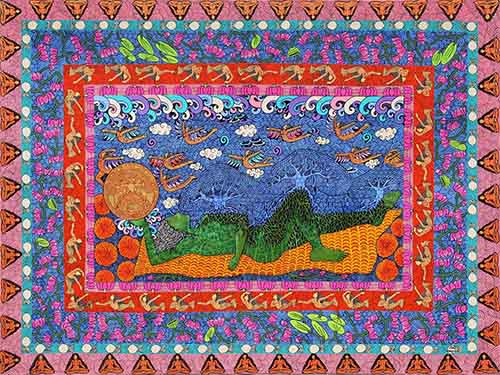
Tell me a little bit about your journey as an artist, Seema. You call yourself a self-taught artist, right?
I say all artists are self-taught, because being an artist is about the individual language. Institutions are important for us to understand the mediums, and you can get inquisitive and have dialogue with so many different people and artists. I did attend South Delhi Polytechnic, Triveni and I owe a lot to those institutions and most importantly the institution of family. But, becoming an artist is a very internal journey and you have to explore within yourself and learn your own language.
In one of your books, you write about how you married young and how you felt ‘subservient,’ that you only painted in the night time. What was that time in your life like?
It is a very personal statement that I made there — ‘subservient’ — I can’t blame anyone for that. At the time, it felt very important for me to play these roles and play them right. But this obstructed my art because I was somebody’s wife, somebody’s daughter, somebody’s daughter-in-law, somebody’s sister-in-law and even somebody’s mother. It is only later that I realised that being a mother was a liberating kind of experience, because I think children are the first critics, and they really help you grow. They are the ones who push you to the boundaries.
So what I meant by subservient was that I was obstructing my internal growth as an artist and my expression as an artist. I was very careful with what I was drawing, how much time I was giving to art so that it should not affect my duties as a housewife. It came to a point where I had a breakdown and decided to leave my marriage.
Faith and a little madness got me through. I just knew I was free to paint, I was so happy to get up and have tea with my canvas. I felt that I cheated on my art by not giving it respect, and now that I had got my opportunity, I shouldn’t leave it a moment. I was happy that my fate and my ancestors blessed me with this time.
But you weren’t angry with anyone.
The moment you are true to yourself, the bitterness goes away. You understand not only yourself but also the other — there is nothing to be bitter about, because everyone plays their role according to their own ‘samskaras.’
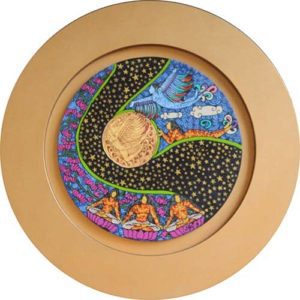
And somewhere along the way, you discovered how to be true to yourself.
When I was painting before, I would think a lot about it and do a lot of sketches. Now I don’t do any sketches at all. Whatever I feel like from within, I let it just flow, and that’s how I know I’m more at peace now.
You mentioned your fate and your ancestors. Can you talk more about that?
My grandfather was a spiritual and awakened soul. My father was too, and the whole family atmosphere was congenial. We didn’t have a temple in the house, but we knew a lot of mantras. Once when I was 3 or so, I couldn’t sleep so I learnt Gayatri Mantra, and it became a habit. I was lucky to have a very secular upbringing where we didn’t have a prejudice towards any religion or the sense of belonging to a particular religion.
How can the story of your journey be useful to other artists?
Artists have to accept certain aspects of themselves which are selfish, but this is not a negative thing. Are you honest with yourself, doing something for yourself? By the time you are creating something of your own, you are also giving something to society, to others. The fragrance of the society is art. But not all are artists or can be artists.
Is there transparency between you and yourself? When you wake up, do you see yourself in your paintings? If there is a difference, then you need to work on it.
Thank you so much Seema.
I hope you have enjoyed these insights into artist Seema Kohli’s distinctively dreamy style and spiritual approach. Each of her works incorporates multilayered stories from myths, spirituality and philosophy, from lotus flowers to the Tree of Life. Her canvases glimmer with 24 carat gold and silver leaf, and her vibrant colors warm the heart.
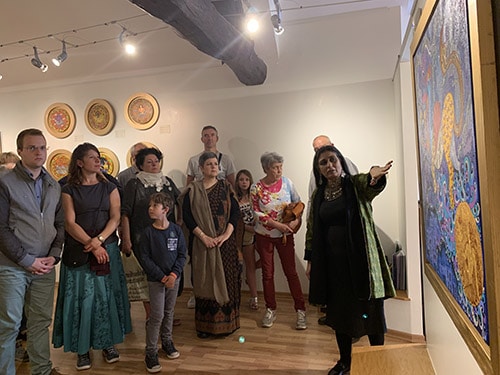
Please visit https://laasyaart.com/seema-kohli/ to view more art by Seem Kohli. If you would like to make an appointment to see her work in person at our Indian art gallery in Palo Alto, please reach out at info@laasyaart.com or +1 650-770-9088.
— Sonia Nayyar Patwardhan
Leave a Reply
You must be logged in to post a comment.