

INTERVIEW WITH CONTEMPORARY INDIAN ARTIST BASUKI DAS GUPTA
Basuki Das Gupta is a man of many talents — he is not only a contemporary artist but also a theater actor, a composer of music, a singer and a skilled musician across multiple instruments. A free spirit, he lives life on his own terms, and that has given a striking depth and vibrancy to his artworks.
I recently interviewed Basuki about his creative process and his sources of inspiration, and he generously shared his life’s story and the technique behind his evocative paintings.

Basuki, what does art mean to you?
It’s oxygen for me. It’s like breathing — if I don’t make art, then I am not breathing, it feels like I am suffocated.
The process of creating your mixed media paintings is very interesting, as you often incorporate newspapers, fennel seeds and fevicol. Can you speak more on that?
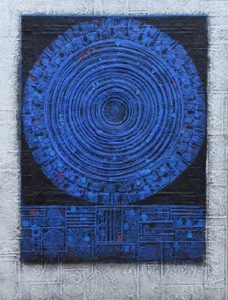
First, let me tell you why I use these materials. I was born and brought up in Bishnupur, West Bengal, surrounded by terracotta temples. In the corridors of those temples, I was always touching the paintings and murals on the walls, when I was crying or happy. Maybe it helped me to overcome all those moments of crisis that I went through. So whenever I touch my own paintings now, all my childhood emotion comes back.
When I am painting, texture is my first priority. It’s a very physical experience. I use paper pulp, texture white and many other things like cloth.
Describe your journey to me, from teaching in Tumkur to where you are today.
I was living in Kolkata wanting to be an artist, to be part of theater and music too. But it is a big city with a lot of people aspiring to be artists of different forms. There was no space for newer ones.
Then I got an opportunity to come to Tumkur, which is a huge place with hills and rocks, a vast spread of sky. I prefer to stay in a place like this, so I started liking Tumkur. My salary was low but the school was fantastic. I was appointed as a visual arts teacher but I experimented with other subjects, integrating science and art, history and art, literature and art. For example, we had ‘ancient Egyptian day’ where we replicated the architecture, clothing design, food habits, market places. Students didn’t realize that they were actually learning about history!
I was so happy with the school that I never thought that I would be a professional artist. But when my daughter was born, there was a turning point where I realized that I needed to earn some money. So these financial insecurities forced me to begin making and selling art again. I would go to the city in the hope of getting at least two or three thousand rupees extra. Initially it was difficult, there was no money to buy food for my daughter, but ultimately it was an opportunity. My wife is very supportive — for five years, she didn’t buy any clothes or luxuries for herself.
After two failed exhibitions, I finally had a successful show and began to achieve something as an artist. Suddenly I earned 2 lakh, around 2006, and it was such a huge amount that my wife was worried for me to go home alone by bus. So she and my little daughter came with me. I carried one lakh each safely in both my pockets. When we think of it now, those adventures were fun.
It sounds like your wife has played a big role in your success as an artist.
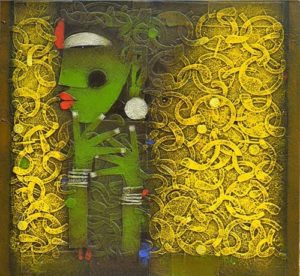
I began to do something constructive in my life because of my wife. I had a very ‘take it easy’ attitude. Something is coming my way, something is going… There was no idea of settling down, of doing something constructive. I used to paint and draw on paper but never maintained it. My wife brought order into my life.
Thank you, Basuki!
I hope this interview sheds a new light on Basuki’s artwork. For instance, his immense love for his wife clearly shines through his paintings of independent, self-assured women. His Ipshita series encourages positivity and confidence in women, while his paintings of Goddess Durga, who is revered in his home state of West Bengal, celebrate feminine strength and power. His newest abstract series also explores influences from his countryside upbringing, such as the sun temple at Konark or elements of nature like waves, sunflowers and the sun itself.
Please visit https://laasyaart.com/basuki-dasgupta/ to browse our collection of art by Basuki Das Gupta. If you would like to make an appointment to see these paintings in person at our Indian art gallery in Palo Alto, please reach out at info@laasyaart.com or +1 650-770-9088.
— Sonia Nayyar Patwardhan
Leave a Reply
You must be logged in to post a comment.